Author:AronDate:2026-9-10
How do you choose the right leather for golf cart seats? Durability is the bottom line!
Golf carts are often parked outdoors, exposed to sun, rain, and significant temperature fluctuations, while also enduring frequent friction and abrasion. If the wrong seat leather is chosen, issues such as fading, cracking, peeling, and stubborn stains will quickly arise, directly compromising the user experience. So, how should you select the right synthetic leather material for golf cart seats?
I. Climate Determines Long-term Performance of Golf Cart Seats
As essential outdoor transport vehicles for golf courses, scenic resorts, high-end real estate parks and farm camps, golf carts are parked and operated outdoors all year round, enduring complex natural conditions. Intense ultraviolet rays, continuous rainfall, high humidity salt spray, extreme heat and severe cold will continuously erode seat fabrics and foam substrates, which are the primary causes of seat aging and damage.
During the implementation of many overseas projects, we notice that most buyers pay more attention to vehicle appearance, driving range and overall price in the selection stage, while easily ignoring the long-term impact of local climate on seats. Within only a few months after operation, seats may suffer color fading, leather cracking, sticky surface, collapsed foam, mold growth and other defects. Frequent seat replacement brings recurring procurement costs, reduces riding experience for tourists and property owners, and harms project reputation.
-3426710.png "WORK (17).png")
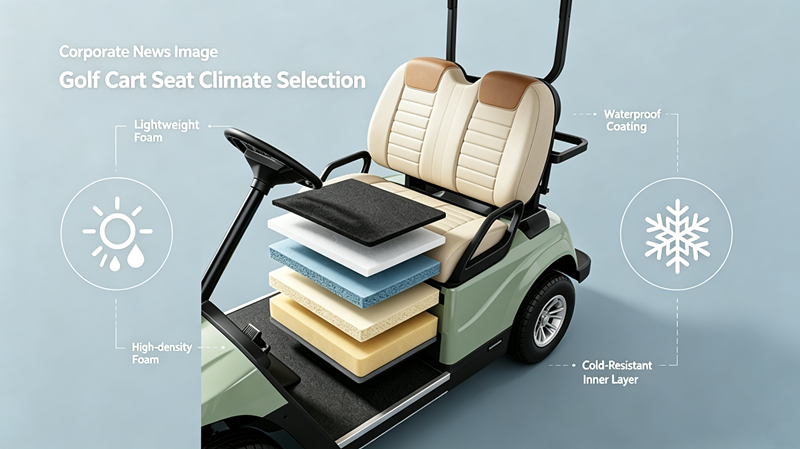
Seats are not universal standard accessories. The selection of fabric, foam and stitching process must match local climate conditions. Only selecting seat materials suitable for the climate can effectively extend service life, cut long-term maintenance costs and ensure stable and comfortable riding experience. For customers across the globe, we have developed multiple sets of golf cart seat material selection schemes for various climate environments.
II. High-temperature & Strong Sunlight Areas: UV-resistant Seat Materials Recommended
Tropical and subtropical arid resorts feature long sunshine hours and strong ultraviolet radiation all year round, with extremely high surface temperature in summer. When ordinary faux leather is exposed to blazing sun for a long time, UV rays will damage the polymer structure of materials, resulting in faded patches, sticky and hard surface, fine cracks and aging. When exposed to persistent high temperature, common foam will soften internally and easily collapse under pressure after long-term use, making seats lose supportive performance.
-3002500.png "WORK (23).png")
For projects in hot and high-sunlight regions, we adopt special leather with UV stabilizer. The leather surface is equipped with thick anti-UV coating to block ultraviolet damage and slow down fading, aging and cracking. The high-density heat-resistant foam filled inside the seat will not soften or rapidly collapse under continuous high temperature, maintaining stable support after long-time riding. Meanwhile, the fabric surface is treated with anti-oxidation finish, resisting high-temperature oxidation. Even exposed under strong sunlight all year round, seats can keep good appearance and hand feel, suitable for tropical golf courses, island resorts and arid camps.
III. Humid Coastal & Rainy Regions: Waterproof & Salt-resistant Seats
Coastal resorts, island scenic spots and regions with perennial rainfall maintain high air humidity all year long. The coastal air contains abundant salt, and salt spray carries strong corrosiveness. Conventional seat fabrics have weak moisture resistance; mold and peculiar smell tend to grow rapidly in humid environments. Salt spray will gradually corrode leather surface and stitching, leading to peeling, delamination and broken stitches. Rainwater seeping into seats is hard to dry out with ordinary foam, further accelerating mildew and decay.
-5755537.png "WORK (18).png")
For humid coastal scenarios, we recommend marine-grade waterproof PVC leather seats. The fabric itself is waterproof. All stitching joints of seats adopt sealed waterproof craftsmanship to prevent rainwater from penetrating into the interior. The material is formulated with anti-salt-fog ingredients to resist corrosion from coastal salt and prevent peeling and aging. Dust, rainwater and splashed seawater on seat surface can be simply wiped with wet cloth for easy maintenance. The whole set can adapt to long-term high humidity and salt-fog environment, widely applied in coastal tourist towns, island golf courses and coastal real estate sightseeing projects.
IV. Cold Low-temperature Regions: Flexible Cold-resistant Seat Leather
High-altitude scenic areas and northern cold zones feature low winter temperature and huge temperature difference between day and night. Ordinary artificial leather will lose flexibility under low temperature, turning hard and brittle. Cracks may easily occur under slight extrusion and friction. Elasticity of common foam decreases greatly in cold weather, resulting in stiff seats and poor riding comfort. Repeated freeze-thaw cycles will eventually pulverize and damage the foam.
-1189344.png "WORK (19).png")
For projects in frigid low-temperature areas, we adopt flexible low-temperature resistant leather. Modified by low-temperature formula, the fabric remains flexible and will not turn brittle and crack in freezing weather. Matching cold-resistant foam retains elasticity at low temperature to guarantee soft riding comfort in winter. Seat materials pass low-temperature aging test, capable of enduring repeated freeze-thaw cycles without cracking, peeling or foam failure. It is suitable for northern scenic areas, high-altitude camps and supporting shuttle carts for ski resorts.
V. Custom Seat Solutions for Global Climate Requirements
The climate varies greatly around the world, and no single seat can adapt to all climate scenarios. High temperature, humid salt fog and severe cold impose completely different requirements on seat fabric, foam and auxiliary materials. As a professional manufacturer of electric golf carts, off-road utility vehicles and sightseeing vehicles, we possess complete independent R&D and customized production capacity for seats, and can provide full customization service of golf cart seats for global clients.
-4130521.png "WORK (20).png")
After receiving customer project requests, our technical team will recommend targeted upholstery, foam formula and stitching solutions one by one, based on local climate, road conditions, annual operation hours and budget. Custom options include seat color, diamond stitching, seat shape and embroidered LOGO. From raw material selection and sample prototyping to vehicle assembly, strict quality inspection is implemented throughout the process. We deliver complete vehicle solutions balancing durability and riding comfort for golf courses, resorts, scenic spots and real estate projects worldwide. We keep deepening our overseas market layout. Relying on refined customization capability, we help customers avoid vehicle wear problems caused by climate and realize long-term stable vehicle operation.
↓Next [ How to Maintain EV Battery, Motor & ECU in Hot and Humid Summer Weather ]